Why the Basque coast needs its own garden logic
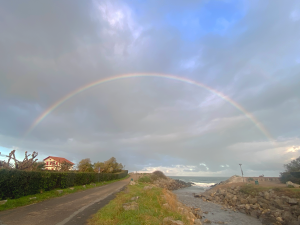
The Basque coast is not England and it shouldn’t look like it. We have a different climate, different ecosystems, different wind, different soils, different seasonal rhythms. Yet our gardens often look like they were copy-pasted from London suburbs, with the occasional palm tree thrown in to suggest we live in Marbella.
It’s a strange situation: we live in one of the most unique landscapes in Europe, but we garden as if we live in a generic global suburb. Some habits seem to die hard.
Spring, as the start of new life, might be a good moment to reflect on this.
As everything will slowly turn green again, especially with the amount of rain we have seen, it will soon feel abundant and healthy again. But while the Basque coast might become lush and alive in the coming months, our summers are less forgiving these days, bringing hotter days and longer droughts. All the more reason to understand well the place we inhabit and stop pretending like all gardens can and should look the same.
A mild Atlantic climate… with increasingly Mediterranean moods
If you garden here, you know the feeling. Winters are gentle. Frost is rare. Plants grow for much longer than in northern Europe. In theory, it’s paradise.
But we’re also on a narrow strip of land exposed to salt winds and storms, with sudden heatwaves, torrential rains and long dry spells that arrive with an almost theatrical confidence.
So what kind of climate is this, really?
It’s Atlantic coastal: mild, humid, and windy. But it’s also increasingly defined by a “wet winter / dry summer” rhythm. Spring rains can make everything look like Ireland, and then July arrives and you suddenly start wondering why your lawn has turned into a beige carpet.
This is the gardening reality here: lush growth, then stress.
And that’s exactly why the Basque coast shouldn’t be designed like England. The British lawn model assumes a soft, steady moisture cycle. Lawns are not just unnatural here, they are very needy. They demand water, fertiliser, and constant maintenance just to stay alive through summer. If you have a lawn, you will be aware of its demands.
The Mediterranean pebble-garden trend isn’t the answer either. Gravel and pebbles can work beautifully in the right context, but the Basque coast is not a dry scrubland.
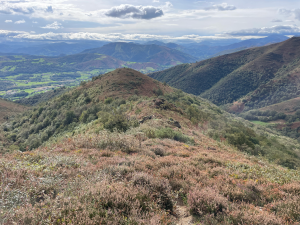
Our natural landscape is shaped by something much more specific: wind, salt spray, thin soils, steep slopes, erosion, and instability. The vegetation that truly belongs here is often low, dense, and sculpted by the elements. Think of the coastal cliffs and their aérohaline grasslands, the heathland-like lande littorale, the dunes (rare here but still present), and the estuaries and wetlands tucked behind the coastline.
In other words: this coast is not designed for decorative softness. It’s designed for resilience.
So the most natural garden model here is not a lawn. It’s not a desert garden either.
It’s a Basque coastal mosaic: a mix of sheltered woodland pockets, hedgerows, dense shrubs, meadow-like patches, and hardy coastal vegetation adapted to wind and salt.
Trees for shade. Shrubs for structure. Groundcover for soil life. Meadows where appropriate. And enough messiness to let life do what life does.
Our coastline is crowded. Gardens are the remaining “green infrastructure.”
Between Bayonne and Hendaye, the coast is dense. Towns, villas, second homes, roads, roundabouts, golf courses, car parks, walls, fences. This is not wilderness. It’s a carefully managed human landscape.
Which makes one thing quietly important:
A very large share of the green you see here is garden space.
Not forest. Not protected habitat. Gardens.
I can’t give you a scientifically perfect number without a detailed land-cover analysis, but a realistic estimate is that 30–50% of all visible green space on the coastal strip is private gardens (and you see similar proportions on the Spanish side).
That’s an absurd percentage when you think about it. It means the ecological character of the Basque coast is being shaped—day by day—by what people plant behind their fences.
And those gardens are not neutral. They influence everything: insect populations, bird life, soil health, water retention, heat buffering, even how rainwater behaves when it hits the ground.
Gardens here are not really nature, but only a substitute for nature. And because we treat them as decoration, they often look the part, but they don’t behave natural anymore.

Native, non-native, invasive: three categories, three very different stories
If we want to talk about planting properly, we need three words.
Native species are plants that evolved here naturally, over thousands of years, in partnership with local insects, fungi, birds, soils, and climate. They belong to the Basque ecological machine. They are part of the operating system.
Examples are things like oak, hazel, hawthorn, blackthorn, elder, wild roses, alder, and plants like wild oregano, yarrow, and clover.
Non-native species are plants that were introduced by humans. Many are perfectly harmless in the sense that they stay where they are planted. They don’t spread aggressively. They just sit there and look pretty.
On the Basque coast, common non-native favourites include hydrangeas (hortensias), palm trees, mimosa, eucalyptus, agapanthus, photinia, pittosporum, and—of course—bamboo, the plant equivalent of a midlife crisis.
Non-native doesn’t mean evil. It just means: not from here.
The issue is that many non-native ornamentals are basically ecological introverts. They may flower, but local insects don’t necessarily recognise them. Or they produce leaves that local caterpillars can’t digest. Or they provide shelter, but not food. They can look lush while being biologically underwhelming.
Then we have the third category, the one that turns polite gardening conversations into neighbourhood wars:
Invasive species.
An invasive plant is non-native, but with ambition. It spreads on its own, escapes gardens, colonises dunes, wetlands, road edges, riverbanks, and slowly replaces everything else. Invasive species don’t just alter the landscape, they damage the landscape.
The Basque coast has a few famous offenders.
Pampas grass (herbe de la pampa) is the obvious one: beautiful in a vase, disastrous on dunes. It spreads fast and forms dense stands that push out native vegetation.
Carpobrotus (griffes de sorcière), that succulent groundcover you see on cliffs and dunes, is another. It creates thick mats that suffocate local dune ecosystems.
Baccharis halimifolia is a major invasive shrub in wet coastal areas.
And bamboo deserves an honourable mention: not always invasive in the official ecological sense, but often aggressively invasive in the practical, neighbour-destroying, pavement-cracking sense.
Why do we plant so many exotic species anyway?
Gardening is big business, and the global nursery industry is extremely persuasive. Its logic is rarely local. It’s built around aesthetic trends rather than ecological belonging. It sells atmosphere: “Mediterranean charm”, “tropical vibes”, “Zen minimalism”. And through magazines, commercials and social media, it quietly shapes what we think a garden is supposed to look like.
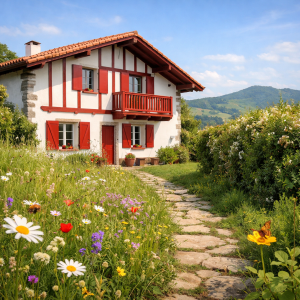
The result is that many Basque gardens feel like cultural imports. The same plants appear everywhere: the same palms, hedges, decorative grasses and sterile lawns.
Somewhere along the way, our gardens became a trendy hobby, a matter of style and identity, yet they all ended up looking the same. It might look green and photograph well, but it has very little to do with this place. And that’s a pity.
And it’s also a creative tragedy, because local nature is not exactly short on beauty. You don’t need to import exotic plants to make something stunning here. You just need to look around.

The pesticide trap: the garden version of panic buying
Then there’s the chemical reflex.
Aphids appear, so we spray. Snails arrive, so we poison. Ants become annoying, so we declare war. A plant looks slightly sad, so we buy a bottle of something with an angry label and a skull symbol in small print.
Industrial agriculture uses enormous amounts of chemicals, and that’s already depressing. But in gardens, the issue is often how chemicals are used. Home users rarely apply products with precision. Dosages are guessed. Timing is random. Spraying happens during flowering. The wind takes it elsewhere. The wrong product is used for the wrong target.
Chemicals don’t just kill whatever we decide to call a bug or a weed. They kill indiscriminately. Aphids, yes — but also bees, hoverflies, ladybirds, soil organisms, and the insects that quietly keep the whole system balanced. You remove one visible nuisance and often wipe out the invisible army that would have kept it under control for free.
The irony is that the more we sterilise gardens, the more fragile they become and the more intervention they require.
So what does a Basque garden look like when it actually belongs here?
It doesn’t mean you need to recreate a forest. It doesn’t mean you need to turn your garden into an ecological protest statement. And it definitely doesn’t mean you have to remove every non-native plant you already own.
It simply means: lean into the local logic.
A Basque-coast garden that supports life tends to have a few recognisable traits:
- Trees that create shade and humidity (and soften heatwaves)
- Shrubs and hedges that offer shelter for birds and insects
- A layered structure: tall, medium, low, groundcover
- Soil that stays covered (mulch, leaf litter, plants—not bare dirt)
- Meadow patches instead of endless lawn
- Wild edges, where things are allowed to self-organise
- Seasonal change, instead of constant visual control
It looks less like a showroom and more like a small landscape. It feels rooted.
And it is also, conveniently, better adapted to drought, rain, wind, and the slightly unpredictable Basque mood swings that summer now delivers.
A small list of local species that are genuinely beautiful (and available)
If you want to start planting in a way that makes sense here, you don’t need a PhD. You just need a shortlist.
A few strong candidates for this region:
Trees / large shrubs
- Strawberry tree (Arbutus unedo) — evergreen, drought-tolerant, beautiful berries
- Oak (Quercus robur / Quercus petraea) — biodiversity champion, long-term structure
- Hazel (Corylus avellana) — great for wildlife, fast-growing
- Elder (Sambucus nigra) — flowers, berries, pollinators love it
- Alder (Alnus glutinosa) — excellent near wetter soils
Shrubs
- Hawthorn (Crataegus monogyna) — shelter, flowers, birds adore it
- Blackthorn / Sloe (Prunus spinosa) — early flowering, dense habitat
- Wild rose (Rosa canina) — beautiful, tough, useful
- Broom (Cytisus scoparius) — iconic spring colour, insect-friendly
Flowers / ground layer
- Yarrow (Achillea millefolium)
- Wild oregano (Origanum vulgare)
- Clover (Trifolium repens / Trifolium pratense)
- Cornflower (Centaurea cyanus)
- Poppy (Papaver rhoeas)
None of these are exotic. None are fashionable in garden catalogues. Which is exactly why they’re interesting.
They belong. They work. They recruit life.
The simplest strategy: reduce lawn, add structure, let life in
If you want a practical starting point, think in zones:
Keep short grass where you actually walk, sit, or play.
Then let the rest become something more intelligent: shrubs, meadow, groundcover, shade, edges. A garden designed like a living coastline, not like a carpet.
Because the Basque coast is not a lawn ecosystem. It never was.
Once you start seeing your garden as a part of a wider landscape, connected to dunes, cliffs, wetlands, hills, insects and birds, you can’t unsee it. The garden is more that a decorative project, it is tribute to our place.
And if you’re not sure what to do…
Do nothing.
Seriously.
Don’t plant anything. Don’t spray anything. Don’t “clean” everything. Don’t mow one corner. Don’t prune the hedge into a geometric cube. Just stop intervening for a moment.
Nature has been building ecosystems for a few hundred million years. It knows the Basque coast better than we do.
And in Part II of this Spring Special, we’ll talk about the one intervention we do obsessively here—mowing and pruning—and why the smartest gardening move is often to cut less, later, and only where it actually makes sense.